Managing a bustling family life often leaves little time for household tasks. Yet, having a well-structured space for your food items can make daily routines smoother. In just two hours, you can transform your pantry with some practical strategies. This approach is based on insights from professional organizers who completed a mini-makeover in record time.
Every family needs a different organizing strategy. You still need to buy groceries, even while reducing clutter. The process begins with purging unnecessary items and cleaning your shelves. Next, you’ll measure your space and create zones for easy access. Choosing the right storage solutions, like baskets and clear bins, is crucial for maintaining an efficient system.
Labels will help everyone find what they need quickly. Expect flexibility in your setup, whether you have a dedicated pantry, a shallow cabinet, or a compact space. With these practical solutions, your kitchen can become a more organized haven.
Key Takeaways
- Transform your pantry in just two hours with effective strategies.
- Tailor your organization approach to fit your family’s needs.
- Start by purging and cleaning before measuring your space.
- Use baskets and clear bins for practical storage solutions.
- Labels enhance accessibility and efficiency in your pantry.
How to organize kitchen pantry by clearing out what you don’t need
When life gets hectic, household organization often falls by the wayside. A great first step in your journey is to start with a quick purge. Spend just 30 minutes removing every item from your pantry. This way, expired and stale food won’t hide behind newer packages.
As you empty the shelves, take the time to check expiration dates and inspect opened packages. Set aside any items your family no longer enjoys. Remember, “It’s better to donate safe, usable food than let it go to waste.” Keeping only what your household intends to eat prevents clutter from sneaking back in.
Once you’ve decluttered, use the empty shelves to identify duplicates and ingredients that need less space. This will make it easier to plan your next steps in creating a functional space.
Clean your pantry and prepare the shelves
In the hustle and bustle of family life, household chores can often take a backseat. Yet, a clean pantry can make a significant difference in your daily routine. Start by wiping down every shelf after removing all food items. This is especially important in a shallow pantry, where crumbs and spills are easy to spot.
Consider adding shelf liner for a cleaner surface. This simple step can refresh older shelves without the need for replacement. Additionally, take the time to adjust shelf heights. This allows you to fit cereal boxes, baking supplies, and appliances comfortably, rather than forcing them into fixed gaps.
As you clean, check for dark corners. A fresh coat of white paint can improve visibility, making it easier to find what you need. Finally, ensure there’s enough clearance for containers and packaged foods. This will keep your pantry practical during busy weekday mornings.
Sort pantry items into family-friendly zones
Juggling family schedules can often lead to chaos in your food storage. Creating distinct zones in your pantry makes it easier for everyone to find what they need. By grouping similar items together, you establish a predictable home for each food category.
Consider broad zones for breakfast, dinner, snacks, baking staples, canned goods, and specialty foods. For example, one family placed a snack basket on a lower shelf. This allows children to help themselves to their favorite treats. It’s a great way to encourage independence!
Additionally, if someone in your family has dietary restrictions, reserve a separate shelf for their safe foods. This is especially important for children with conditions like celiac disease. Keeping lunch items, fruit, chips, and crackers in distinct baskets helps kids pack their own snacks without rummaging through everything.
Remember, the goal is to create categories that match your family’s routines. Don’t feel pressured to copy a professional organizer’s layout. Your pantry should work for you!
For more tips on efficient home organization, check out this resource.
Measure your pantry space and plan your layout
Amidst the chaos of daily routines, measuring your storage space is crucial. Accurate measurements will help you determine what fits and what doesn’t. Start by checking the width, depth, and height of your shelves or cabinets. For instance, one pantry had shelves measuring 9.5 inches deep, while another cabinet was designed at 12 inches deep.
Before shopping for organizers, make a list of what needs to fit. This ensures that every item has a designated spot. Measure each cabinet or closet’s width, depth, and height to avoid mismatches. Remember, a 9.5-inch shelf cannot accommodate every standard container.
Record shelf openings and vertical gaps so that cereal boxes, baskets, and small appliances fit without wasted space. Also, create a complete inventory of what must return, including food, paper products, and children’s dishes. Compare your measurements with the 12-inch pantry cabinet example to decide on the best storage options.
Finally, plan your layout before ordering any IKEA-style system. Remember, ALGOT components are sold individually, so a clear plan is essential.
Choose pantry storage that works for your kitchen and budget
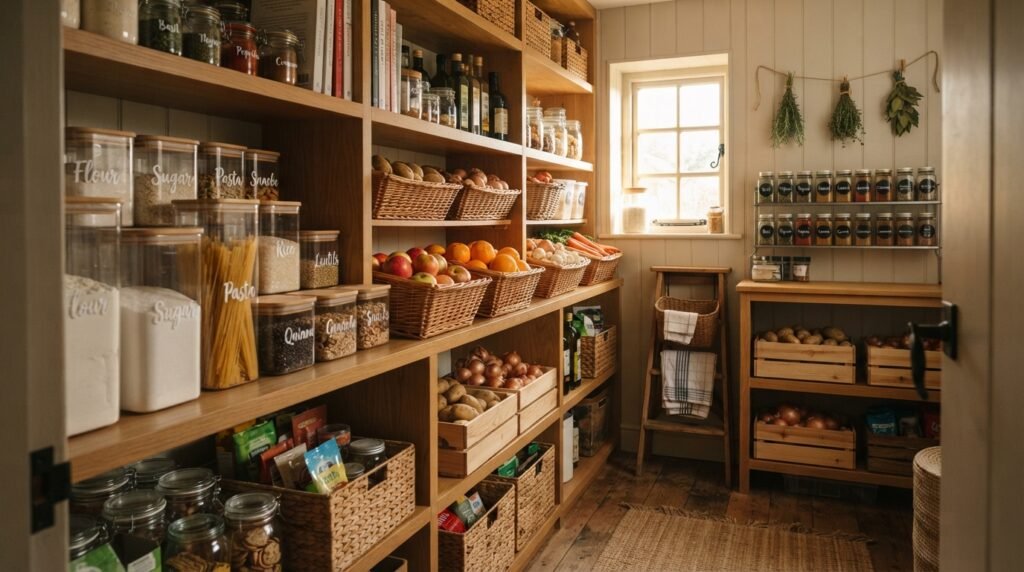
Finding the right storage solutions can greatly enhance your food organization. Selecting appropriate bins and baskets can make a world of difference. For example, opaque Water Hyacinth Storage Bins effectively conceal messy packaging, while clear iDesign Linus Pantry Bins allow you to see contents at a glance.
Utilizing a variety of storage options helps you manage space efficiently. Consider adding a three-tier riser for canned goods. This keeps items visible and prevents expiration. Lazy Susans are perfect for organizing snack bars or oils, ensuring easy access.
For deeper shelves, pull-out trays can function like drawers. They make it easier to reach items without moving everything in front. In small cabinets, using vertical space is key. The IKEA BOAXEL system maximizes storage, while the IKEA RASKOG cart provides portable options.
| Product | Type | Benefit |
|---|---|---|
| Water Hyacinth Storage Bins | Opaque Bins | Conceals packaging |
| iDesign Linus Pantry Bins | Clear Bins | Durable and visible |
| The Home Edit Lazy Susan | Turntable | Easy access for snacks |
| The Home Edit Three Tier Shelf | Riser | Visibility for canned goods |
Decide what to decant and label
Finding time for food organization can be a challenge for busy families. One effective way to simplify your food storage is by transferring frequently used dry goods into airtight containers. This approach not only makes pouring easier but also helps preserve freshness.
Consider decanting items like cereal and baking ingredients that your family uses regularly. However, it’s wise to skip this step for foods that are consumed quickly. Transferring them may create extra work without significant benefits.
As you decant, remove bulky boxes from individually wrapped products. This saves valuable shelf space and keeps similar items grouped together. Remember, labeling is essential! Clear labels on every container and basket help everyone know where items belong.
You can print labels on Avery 22818 round labels, use a Brother P-Touch Cube Plus with one-inch tape, or create removable vinyl labels with a Silhouette Cameo. As one expert wisely said, “A well-labeled pantry is a happy pantry.”
Restock your pantry with everyday access in mind
A hectic family life often complicates easy access to pantry essentials. To streamline your cooking and snacking, think about where you place items. The middle shelves are perfect for frequently used foods like cooking and baking supplies, as well as snacks.
Heavier items, such as canned goods and appliances, should be stored on lower shelves. This not only keeps them within reach but also prevents any lifting hazards. For example, you might keep a KitchenAid mixer and a Crock-Pot on these lower shelves.
On the other hand, lightweight and less-used items, like paper towels and napkins, can go on upper shelves. This keeps them out of the way and ensures safety when reaching for heavier items. It’s also a good idea to store children’s snacks at their height, while keeping adult-supervised foods separate.
If you’re stocking your pantry for the first time, start with essentials like canned goods, sugar, flour, common spices, and cooking oil. This approach prevents overwhelming yourself with too many purchases at once.
Create a simple routine to keep pantry organization on track
With busy schedules, it’s easy for food storage to become disorganized. Establishing a simple routine can help maintain order in your pantry. A quick reset at the end of each day ensures that items return to their designated zones.
Make it a habit to check your visible inventory before writing your grocery list. This prevents the common issue of buying duplicate items, like cereal. A short weekly review can also help avoid the need for another extensive overhaul.
Utilizing transparent containers and open baskets makes it easy to see what you need before shopping. Tailor your routine to fit your family’s schedule, keeping in mind that simple systems can be effective. Remember, consistency is key!
- Finish each day with a quick reset that returns snacks, breakfast foods, baking supplies, and canned goods to their assigned zones.
- Check visible inventory before writing a grocery list to avoid repeating the cereal-buying problem.
- Schedule a short weekly review instead of waiting for another two-hour overhaul.
- Use transparent containers and open baskets to make low stock obvious before shopping.
- Build the routine around your household’s schedule, using the three-week maintenance result as evidence that simple systems can last.
Conclusion
A useful food-storage system starts with what your family truly eats. Empty the shelves, discard expired items, and set aside foods no one wants. Clean the surfaces, then measure each shelf’s width, depth, and height.
Build clear zones for breakfast, snacks, baking goods, canned foods, and special-diet items. Choose bins, baskets, risers, turntables, or pull-out trays that fit your space and budget. Decant only dry goods you use often, label shared containers, and keep daily favorites within safe reach.
A few small habits keep the setup working. Reset shelves after use, then check supplies before each grocery trip. This quick routine limits clutter and duplicate buys while helping every family member find what they need. Your system can stay flexible as schedules and tastes change.