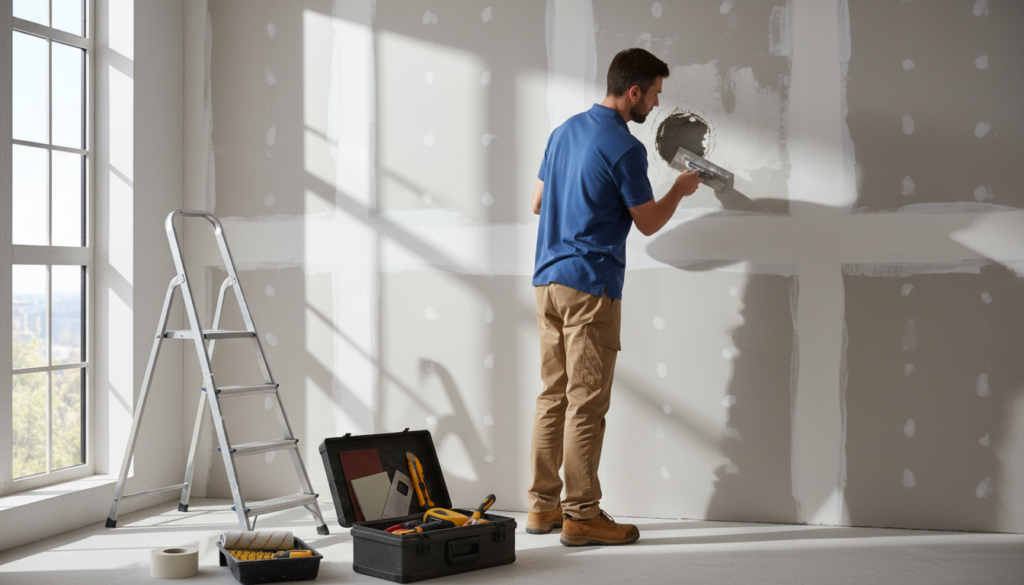
Surprising fact: Nearly 70% of U.S. homeowners say they saved hundreds of dollars by handling minor wall repairs themselves.
You can get a showroom-smooth finish in just a few hours when you learn reliable drywall repair methods. This short guide gives clear steps and the key tools you need. Proper prep and the right tape plus joint compound are the real secret to lasting results.
Whether the issue is a small hole from a doorknob or a larger impact, following each step prevents recurring seams and visible flaws. Taking time early on for sanding and surface prep makes the final finish blend in with the rest of your wall.
Key Takeaways
- Save money: DIY repairs often cost far less than contractor calls.
- Start with clean, stable surfaces for best results.
- Use tape plus compound for strength and longevity.
- Sanding and finishing determine how invisible the repair looks.
- Gather proper tools before you begin to speed the process.
Understanding Drywall Damage
A hairline split or bulge usually tells a bigger story about movement or moisture in the home. Start by looking for the root cause before you pick up tools. Knowing why the wall failed gives you the best chance of a lasting repair.
Identifying Common Causes
Houses shift with age, and that settling often shows up along seams. Humidity swings in bathrooms or kitchens make seams bubble and paper peel.
Why Early Repair Matters
“Fix small problems early and you avoid major work later.”
Minor bedroom cracks can balloon into full re-sheetrock jobs if left alone. Small holes from furniture bumps are common, but the surrounding drywall can weaken and turn that minor hole into a large holes situation.
- Find whether settling, moisture, or impact caused the damage.
- Early action keeps drafts and bugs out and protects resale value.
- DIY repairs often prevent a full re-sheetrock job and save money.
Essential Tools and Materials for Your Repair
Before cutting or taping, gather the tools and materials that make a lasting fix possible.
Start with basics: a tape measure, screw gun, keyhole saw, and a sharp utility knife. Keep a putty knife in the 2–6 inch range for spreading joint compound. Use 1 1/4 inch wood screws for securing backing that won’t shift over time.
Quality supplies save time and rework. Choose fiber mesh tape or paper tape and a high-quality joint compound. A sanding sponge handles final smoothing, especially with quick-set mud varieties.
For bigger openings, use furring strips behind the patch for solid support. A drywall patch kit can speed things up, yet separate components often yield the best finish.
- Gather a reliable set of tools; good gear shortens the job.
- Keep mesh tape, paper options, and joint compound nearby.
- Use a sanding sponge and proper lighting to spot imperfections before paint.
Pro tip: bright portable light reveals low spots that the naked eye misses.
How to Patch Drywall Holes and Cracks Like a Professional
Start by turning the damaged area into a neat square. Cutting a clean square makes installing a new piece drywall faster and far more precise. A tidy opening also limits wasted time and gives straight edges for a tight fit.
Measure the opening carefully so you know the exact patch size. That way you avoid big gaps that take extra mud and sanding. Professionals often use a keyhole saw for straight edges and quick cuts.
Every repair follows a clear step-by-step routine. Secure backing behind the opening so the new material won’t sag. Place the patch so it sits flush with the wall for a seamless finish.
- Cut a square around damaged gypsum for easier fitting.
- Measure for exact patch size before cutting the new piece.
- Support the opening with wood backing for long-term strength.
- Use tape and compound in thin layers for invisible seams.
Expect about three hours from start to finish on a typical drywall repair. Follow this simple way and your drywall patch will blend right in. For more tips, check this DIY repair guide.
Pro tip: work in stages and let mud dry fully between coats to reduce sanding time.
Preparing the Damaged Surface
Begin with a crisp outline; a perfect square makes the rest of the repair much easier.
Use a chalk box to snap straight lines around the damaged area. This gives you a defined border and helps you cut a true square with a keyhole saw.
Score the paper around the perimeter before cutting. Scoring prevents the paper from tearing into the surrounding wall and keeps the surface intact.
Creating a Clean Square
Cut along your chalk lines with a keyhole saw and a sharp utility knife. A neat opening makes inserting the new piece much easier.
- Cut a clean square with steady strokes; it saves time when fitting the patch.
- Score the paper first so edges stay smooth and strong.
- Remove debris and vacuum the area so tape and compound adhere well.
- A tidy opening reduces the amount of mud needed later and supports a longer-lasting repair.
Tip: clean edges mean cleaner seams—this step sets up the whole repair for success.
Installing Wood Backing for Structural Support
Solid backing makes the difference. Install wood furring strips or short blocks behind the wall opening so the new piece has a firm surface for fasteners.
Place the supports so you can drive screws every 6 inches along the patch edge. This spacing reduces movement and prevents future visible seams.
Secure the backing to studs or framing whenever possible. Firm attachment gives the best load transfer and keeps the wall stable in high-traffic areas.
- Furring strips provide a solid surface for screws.
- Screw spacing near every 6 inches limits flex and movement.
- Proper backing makes taping and mudding far easier.
“A rigid substrate is the fastest route to an invisible finish.”
| Backing Type | Recommended Fastener Spacing | Best Use | Benefit |
|---|---|---|---|
| 1×2 furring strip | 6 inches | Medium to large openings | Solid screw hold, easy alignment |
| Short wood block | 6 inches | Irregular or odd-shaped holes | Custom fit behind small openings |
| Stud anchoring | 6–8 inches | Edges near framing | Strongest permanent support |
| Metal backing clip | 6 inches | Thin or metal studs | Prevents wood distortion, durable |
Cutting and Fitting Your New Drywall Piece
A snug new piece turns an awkward opening into a near-invisible section of wall.
First, measure the hole from top to bottom and left to right. Record each dimension so your new piece matches the opening exactly.
Use a keyhole saw for rough cuts and a razor knife to score the board. Scoring gives a clean break and neat edges on every side of the patch.
Test-fit the piece in the opening. A tight fit is the hallmark of quality repair. If the patch is slightly large, trim small amounts with your knife until it sits flush.
- Secure the new piece with screws every 6 inches around the perimeter.
- Check that the patch is level with the surrounding wall on every side.
- Double-check measurements before each cut to avoid wasted material.
Tip: a snug fit prevents gaps and makes the next step—taping and mudding—faster and cleaner.
| Action | Tool | Why it matters |
|---|---|---|
| Measure opening | Tape measure | Ensures the new piece fits without gaps |
| Cut and score | Keyhole saw, razor knife | Clean edges that sit flush with the wall |
| Test fit and trim | Utility knife | Fine-tunes the fit for an invisible finish |
| Secure patch | Drywall screws | Holds the piece firmly to backing every 6 inches |
Applying Tape for a Seamless Finish
A flat, well-embedded strip of tape is the backbone of any seamless repair. Taping bridges the gap between the new piece and the surrounding surface. Done right, it hides the edges and cuts sanding time.
Choosing Between Mesh and Paper
Fiber mesh tape works especially well with quick-set joint compound. It resists movement and speeds up work when you need a fast coat. Paper tape is stronger for inside corners and layered seams, but it takes a little more care.
Avoiding Bubbles
Press the tape gently and pull your putty knife in steady strokes. Using a 10-inch or 12-inch knife helps embed tape without creating mounds near the edges.
- Embed the tape with even pressure so mud spreads beneath it.
- Apply the first thin coat and then let dry completely before the next coat.
- Increase the width of each subsequent coat to feather the joint into the wall.
Tip: pressing too hard squeezes out compound and can trap air, which leads to bubbles.
| Step | Tool | Why it matters |
|---|---|---|
| Select tape | Mesh tape or paper tape | Mesh for quick-set mud; paper for stronger seams |
| Embed tape | 10–12 inch knife | Prevents mounds and keeps the surface smooth |
| Feather coats | Putty knife | Wider coats hide edges and create a seamless finish |
Mastering the Art of Mudding
Good mudding blends the new board into the wall so the repair nearly vanishes.
Start by mixing quick-set joint compound to the right consistency. Quick-set comes as powder and is available in 5, 20, 45, and 90-minute set times. Choose the time that fits the size of your patch and your working speed.
Use fiber mesh tape under the first thin coat for added strength. Apply mud with a wide knife and feather each edge outward so the surface transitions smoothly to the surrounding wall.
If lumps appear, mix the compound more thoroughly. Let each coat let dry before the next pass. Each coat should be wider than the last, with the final coat extending well beyond the hole for a flat finish.
- Thin first coat, embed mesh tape, then let dry.
- Feather edges with a wide knife for an invisible side blend.
- Choose quick-set time based on patch size and available working time.
Tip: it’s fine to walk away and return; a calm, steady approach yields far fewer sanding hours.
| Task | Tool | Why it matters |
|---|---|---|
| Mix quick-set mud | Bucket, drill mixer | Correct consistency prevents lumps and speeds work |
| Embed mesh tape | 10–12 inch knife | Strengthens seam and reduces movement |
| Feather coats | Wide knife | Creates a flat, paint-ready surface |
Sanding Techniques for a Smooth Surface
A few smart sanding moves will erase ridges and leave the wall uniform and flat.
Start by treating sanding as the final step in your repair process. Light passes reveal ridges left from the knife and uneven spots under mesh tape.
Choose grit by stage: use a medium grit sanding sponge for quick-set mud and firmer layers. Switch to fine grit paper for the final coat so you don’t gouge the surface.
- Sand between coats when you spot lumps or ridges; this keeps the next coat thin and even.
- Always wear a dust mask during sanding to protect your lungs from fine particles.
- After sanding, wipe the wall with a damp cloth so primer bonds to a clean surface.
Tip: if the surface still shows low spots, add a thin coat and repeat sanding until flat.
| Stage | Tool | Grit | When to Use |
|---|---|---|---|
| Initial shaping | Medium sanding sponge | 80–100 | Quick-set mud and hard ridges |
| Refining | Sanding block or sponge | 120–150 | Remove light bumps before final coat |
| Final finish | Fine sandpaper | 220–320 | Feather edges for paint-ready surface |
Final check: run your hand over the area in low light. If it feels smooth and looks flat, you’ve sanded enough and saved time that would otherwise be spent on rework.
Matching Texture and Priming
Matching wall texture is the finishing touch that makes repairs vanish to the eye.
Use a sponge rolled in sanded joint compound to mimic common textures such as orange peel or knockdown. Practice on cardboard first until the pattern matches the surrounding wall. That small test saves time and keeps the repair subtle.
- Roll a damp sponge in sanded joint compound and dab or swipe to create the surface pattern.
- Work in thin layers so you can sand smooth between passes if needed.
- Match direction and scale of the texture for a consistent finish across the wall.
Once the texture dries, prime the entire patched area with a high-quality stain-blocking primer. This seals the joint compound and prevents the new paint from flashing or absorbing differently than the rest of the wall. After the primer dries, apply your final paint coats, painting from corner to corner for the most uniform result.
Pro tip: a light scuff with fine grit before priming helps the primer bond and keeps the top coat even.
| Method | Best For | Why It Works |
|---|---|---|
| Sponge roll in sanded mud | Orange peel, knockdown | Quick pattern build; easy to practice and adjust |
| Spray texture | Large areas | Fast coverage; matches uniform factory textures |
| Trowel and feather | Custom textures, deep patterns | Gives control over depth and shape for seamless blend |
Final step: take your time with texture and primer so the repaired area blends and lasts.
Troubleshooting Common Repair Mistakes
Minor errors during mudding or taping are usually the reason a repair reopens or shows through paint.
Dealing with Recurring Cracks
If cracks return, check movement at the source. Roof or foundation settling can reopen seams.
Use quality mesh tape and make sure furring strips are tight. A stable base reduces repeat failures.
Fixing Peeling Paint
Peel often means the surface wasn’t sealed. Always prime new piece drywall before the top coat.
Lightly sand the area, wipe clean, then apply a stain‑blocking primer. This prevents flash and peeling later.
Correcting Mud Thickness
Bubbles usually come from compound applied too thick. Apply thinner coats and let each one let dry.
Feather edges with a putty knife, use mesh tape under the first coat, and sand smooth with a sanding sponge between passes.
Tip: for large holes, verify your patch kit or custom patch has solid support before finishing.
Conclusion
Completing the last steps brings a clean, lasting result that you can be proud of.
This guide showed core drywall repair steps and the tools you’ll need. Follow each step, use quality tape and joint compound, and handle sanding with care. Practice makes the process faster and your drywall patch nearly invisible. Small holes or larger openings both benefit from good backing, a sharp knife, and patient drying between coats.
Take your time and test texture on scrap before finishing. You’ll save money, build skill, and enjoy a smoother wall. Thanks for reading — now tackle future repairs with confidence and pride in the result.